

Image taken from Home Page Testimonials Section. See the section titled "what our partners think" for this endorsement and many more . . .
The Current Outputs for the OSHA Pioneers & Industry MMC Supply Chain

THE OSHA BUSINESS CASE & REPORTS
Following an extensive six-month analysis of pioneer partners’ requirements and aspirations, undertaken through a series of rigorous internal and external working groups, a comprehensive, treasury-style business case was developed to establish the strategic direction for the OSHA programme. This business case encompassed a wide range of critical considerations, including political agendas and challenges, the housing crisis, technology evaluations, industry supply chain management, transactional methodologies, public sector governance, frameworks among RP partners, the imperative for procurement transparency, and, crucially, the anticipated outcomes of the programme. Serving as the principal reference for all subsequent activities, the business case underpinned five years of operational delivery, resulting in the creation of substantial development and deployment reports, as well as key informational documents now available to OSHA partners. In addition, targeted reports were produced for essential stakeholders, such as Homes England, MHCLG, and the Ministers and Secretary of State for Housing, to ensure that OSHA’s leadership approach, is recognised as a pivotal force, in advancing innovative housing solutions, to address the significant national shortfall.

RISK & COST MANAGEMENT
Ottersbrook established a comprehensive risk register as part of its business case requirements, ensuring robust project management across all activities within the OSHA partnership programme. The programme was structured into six stages, each governed by rigorous project management controls. Risk management remained the top priority, especially during extended supply chain engagement. This approach enabled thorough risk assessment, compliance reviews, and cost analysis across the UK, providing valuable comparisons with traditional construction practices and procurement methods.

MMC PROCESS MAPPING
House builders and tier 1 contractors, excel at project management, and management of land. Early attempts by volumetric modular manufacturers to deliver full turnkey solutions, has lacked the pipeline of new homes, and this core skill and experience. This led to significant gaps and increased risk across the industry. OSHA observed that MMC innovation, especially in volumetric systems, requires each party to play its part, with effective collaborative control managed by experts. OSHA found that manufacturing high PMV systems, is best positioned as a supply partner process in housing projects, rather than (most) manufacturers leading the entire process. Of the 43 key steps set out in our MMC DfMA process, MMC delivery, accounts for just three, with the project management team overseeing risk and coordination for the remaining 40 steps. To address these challenges, OSHA mapped the process to identify organisational gaps and to support all stakeholders, during MMC feasibility studies. Today, a range of process maps and tools are available to help review time, cost, and quality, ensuring robust risk management for different contract types and project structures.

DESIGN PATTERN BOOK
One of the most significant outputs of the OSHA programme, was a fully vetted design pattern book, for the many OSHA house types and NDSS arrangements. We were looking to build across many sites and across many OSHA partners. The concept, as part of the OSHA MMC eco system we built, was to manage all of this through aggregated demand towards 10,000 homes per annum, across the 23 original pioneering RP partners. The pattern book took over 18 months to build up, whilst working with 13 supply chain technology partners. This was to ensure that each home could be designed, manufactured, and assembled (DfMA), with any technology, and not fall foul of critical design issues, leading to manufacturing inertia and cost hiking. The pattern book was also subject to rigorous design checking by architects, structural engineers, fire engineers, regulators and certification bodies, as well as M&E specialists, to ensure a robust approach, to the use of MMC technologies and MMC process of engagement. Each specialist was hand picked for their system design expertise, experience in innovative design processes, and for there knowledge of MMC methodologies.
ZERO CARBON PLAYBOOK
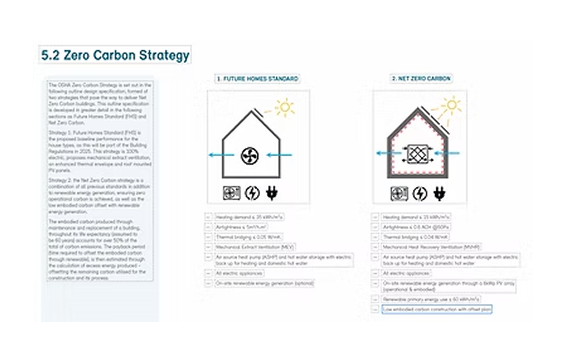
The OSHA Zero Carbon Playbook, builds on our Pattern Book, offering over 60 pages of detailed guidance on energy efficiency, M&E, and environmental and sustainability considerations, for designing MMC homes. This playbook ranges from basic building regulations compliance through to full Passivhaus standards and everywhere in between. Our design proposals are modelled using PHPP and IES software, targeting two performance benchmarks: the Future Homes Standard (FHS) for 2025 compliance, and Net Zero Carbon, the stretch target for 2030 set by many public sector housing development teams. All proposals are compatible with a net zero energy strategy, allowing flexibility for future upgrades, primarily through the feasibility of PV panels on each client's proposed building site.

DATA CAPTURE & PMV REVIEWS
The PMO live expert support log, records all key site activities and partner interactions within the OSHA programme, including site appraisals, supplier recommendations, and procurement strategies. This ensures efficient information flow, real-time visibility, and informed decision-making across projects. Integrated with the OSHA cost database, the platform enables national benchmarking of MMC technologies. Ongoing data updates, support programme evolution. In partnership with CAST as PMO managers, OSHA also provides comprehensive assessment reports, for all sites requiring AHP-funded support. The benefits of this aggregated data control also depends fully on the availability of aggregated demand, and the future funding opportunities that are provided to OSHA. Without these two fundamental elements, OSHA will struggle to maintain its evolved position, as a key support partner for disruptive innovation management, in the housing sector.

OSHA MMC FRAMEWORK
Ottersbrook identified within the business case, very early on, that procurement in the public sector was always going to be a significant challenge, for innovative system approaches. Finding the right solution, with the right supply chain partners, in a market that was constantly evolving, with strict procurement rules, was extremely complex and often difficult to portray to supply chain manufacturers, who were, and still are, offering the best solutions, outside of procurement frameworks and systems. However, after almost 2 years of supply chain engagement, a soft market testing programme, project management of the OSHA platform by Great Places Housing Group's expert procurement team, together with a select number of RP support partners, OSHA launched the MMC Framework, for an initial £2Bn, in 2023. The OSHA National MMC Framework's objective, was to supply 10,000+ homes per year, through the increased use of MMC technologies. The framework also includes a specialist team of MMC experts across many disciplines, with Ottersbrook as Project Directors. OSHA also has its own Project Management Office (PMO) as part of the support package for the framework. The PMO is managed by specialist construction consultants Cast Consultancy, and the Framework has been continually managed and hosted by Great Places Housing Group.

FEASIBILITY ASSESSMENT PROCEDURE
Partners have been informed about the current scope and process for rapid site appraisal processing, with feedback gathered to understand their specific requirements. A handbook has been developed to outline a standardised process, ensuring consistency in assessments. A structured guide detailing the process, methodology, and best practices, has been developed called the rapid site Feasibility Assessment Process (FAP). The ongoing delivery of this procedure, has also been agreed at OSHA, to be available for all combined authority members, specifically GMCA, who have been active funding partners for OSHA since inception. Full training sessions are delivered upon request, via the OSHA Project Director and supporting PMO team at OSHA. This will provide members with a structured, efficient, and scalable process, for conducting rapid site appraisals. By adopting the FAP, members benefit from: 1) a scalable and repeatable process that streamlines site assessments and accelerates project timelines; 2) consistent, evidence-based reporting, that supports robust decision-making and risk management; 3) access to expert guidance and ongoing support from Ottersbrook and the OSHA PMO team (Cast Consulting).

Click image to enlarge
OSHA ULTIMATE MMC TOOLBOX
The OSHA MMC Toolbox provides partners with a robust suite of resources to streamline project delivery and ensure compliance. Key benefits include: Standardised Processes: Simplifies transactions and project management, reducing administrative burden. Enhanced Collaboration: Fosters seamless coordination between partners, clients, and project teams. Data-Driven Insights: Offers access to cost databases and performance analytics for informed decision-making. Quality & Compliance: Supports consistent quality control and adherence to evolving regulations. Risk Management: Delivers frameworks to identify and mitigate project risks. Innovation Support: Facilitates the adoption of modern construction methods (MMC) at scale. Expert Guidance: Backed by OSHA’s PMO, Project Director and other specialist teams, for ongoing support. The Toolbox empowers partners to deliver efficient, innovative, and compliant projects in a rapidly changing construction landscape.

MMC CASE STUDIES
OSHA’s case study template, ensures consistent, high-quality project documentation across all MMC initiatives. For each project, technical teams collaborate to capture key data points, stakeholder roles, project type, timelines, scope, objectives, and sustainability features, with a strong emphasis on energy efficiency and advanced construction methods. The case studies systematically document challenges (e.g., site constraints, logistics), the technical solutions applied, and quantifiable outcomes, such as energy performance, cost savings, and delivery speed. Each case study concludes with lessons learned and best practices, supporting continuous improvement and knowledge transfer across the sector. This structured approach enables robust benchmarking, facilitates peer review, and provides actionable insights for future MMC projects, thus driving innovation and efficiency in construction delivery. OSHA intended to create a significant amount of case studies using all the tools and collaboration we have developed. Ultimately, to share for greater insight and adoption of MMC innovation in the construction sector, specifically for housing.


What Next at OSHA

Industrialised Construction is looming

PRODUCT & SYSTEM TESTING
There are many new measures that have been put in place to ensure a more robust regulatory compliance and monitoring system in the UK, and in other countries. Robust preparation and adequacy of testing, is often ignored because of a lack of building physics consideration or, pre-audit review. 3rd party certificates that have been relied upon in the past, are also under immense scrutiny now, post the Grenfell disaster. Ottersbrook are placed and trusted, to manage complex and small test programmes.

RESEARCH & DEVELOPMENT
Since the early the 1990’s, Ottersbrook directors have been fully operational within the construction sector’s dynamic ‘R&D Ecosystem’. We have been active across a significant mixture of materials, technologies, services, regulations, standards, and policy development activities. We work with many influencers whenever continual improvement or guidance, is sought for best practice delivery. We are also a published government support partner for R&D.

COMPLIANCE & CERTIFICATION
Working with compliance and certification bodies, has been a fundamental part of Ottersbrook’s offering and specialism since inception and beyond. We have exceptionally strong relationships with the major influential bodies in the construction sector. We can ensure that your project does not fall foul of inertia or cost hiking, which is common when approaching a regulatory body, for compliance approval or third party certification.

Df MA BUSINESS PROCESS
Ottersbrook have developed several support areas to enable process flows to operate more efficiently and profitably. This isn’t just based on theory, but because we have also managed manufacturing and delivery businesses for over 35 years, at the coal face. We can map out and analyse your process in a simplified way, or we can create a full DfMA platform using the RIBA (DfMA overlay) plan of works, as your guide for operational improvement.
Opportunities ahead for the SAHP 2026 - 2036 using the OSHA Process of Engagement and Site Management Protocol
The OSHA programme represents a remarkable collective effort, and Ottersbrook is proud to have helped coordinate such committed partners across the sector. Like many ambitious initiatives, its future is shaped by a shifting political landscape and the wider sector’s readiness to embrace new ways of working. Understandably, recent industry setbacks—particularly in the volumetric space—have created caution among clients and compliance bodies. Yet the need for collaboration, trust, and innovation has never been clearer. OSHA’s progress shows what is possible when the sector comes together, and the opportunity now is to build on that momentum with confidence and shared purpose.
The philosophy developed through the OSHA programme remains fully accessible to any public‑sector organisation seeking to deliver exceptional homes through Industrialised Construction. The methods, tools, Pattern book, Zero Carbon Playbook and insights created through this work, are ready to be applied in practice, offering a proven foundation for smarter, more resilient, and more collaborative housing delivery. Organisations who share this ambition, can draw on the OSHA approach to accelerate quality, consistency, and confidence across their projects.
